Posts

Language in Society*

The hypothesis starts when Whorf argues that the Hopi people in Arizona do not conjugate verbs into past, present, and future tenses as English speakers do and that their words for units of time (like “day” or “hour”) were verbs rather than nouns. From this finding, he believes that Hopi people do not see time as a physical object that can be counted in minutes and hours, as contrast to English speakers. Hopi people, according to Whorf, view time as a formless process. Others than account that Hopi people do not have any concept of time (Green, 2023) . Its relativity can also be seen from a number of languages. English and many other European languages normally that perceive the future in front of us and the past as being behind us, in Swedish for instance (framtid/front time). But In Aymara language, spoken by Aymara people who live in Andes in Bolivia, Chile, Peru and Argentina, the word for future means “behind time”. They tend to make backward gestures when talking about future...

Theoretical and Applied Psycholinguistics*

One of the topics covered here is about the stages in children language acquisition. This section provides useful information about ages, that all parents or caregivers need to be aware of, should come along with their vocabulary accretion. Meaning that children in a particular age should indicate a particular tier of recognized and meaningful words. Furthermore, this also addresses the speech and language delay, that is increasingly becoming an anxious issue especially in the last two decades. The students doing language studies can make the most of this book. The reason for this is that Psycholinguistics is one of the course units offered. The materials that are presented friendly-language use can help them to gain understanding effectively. However, non-linguistics students such as Psychology, and practitioners, researchers, teachers, parents, and anyone interested in children language development can take advantage of it too. This could be a source for further developmental knowl...

Understanding IPM (Information Processing Model) in a Practical Context

Image
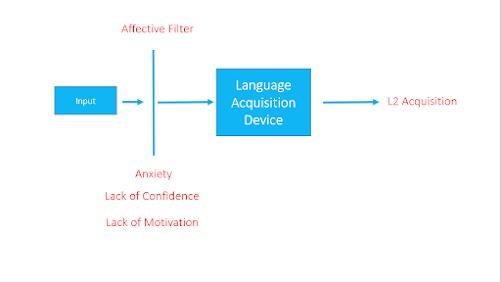
Affective filter is one of the IPM (Information Processing Model) elements proposed by Stephen Krashen. The input hypothesis proposed by him include five features: acquisition-learning, natural order, monitor, comprehensible input, and affective filter. This writing is, however, mainly focused on the affective filter point.  My students, who are studying English as a second language, inspired me to recall this point and I see the importance of introducing this idea to them. One of their questions was concerned about the language learning barrier, or the contributing factors to why language learning does not take place. It is understandable since the language learning assessment was done as their self-reflection to their language learning achievement. When I asked them "How good you are at listening, speaking, reading, and writing". Their responses indeed vary. One is good at listening, reading, writing, and speaking. But none of them claimed that they are competent in those f...

Lexical Variation

Image
The notion of lexical variation refers to vocabulary variation within a language. Once the language is used in different regional boundaries, each region may have its own variation to express the same thing with different words. Studies have shown lexical variations apply to languages. One of the Javanese studies conducted in Bojonegor regency, East Java shows lexical variations. Three regions such as Kanor, Baureno, and Gondang sub-districts use the same lexical unit for Bottle. In those regions, their speakers have the same word for Bottle: Botol. However, the speakers from Tambakrejo use Gendul. Another example is Bathroom. In three sub-districts, Kanor, Baureno, and Gondang, they use Jedding to refer to that gloss. However, people in Tambakrejo sub-distric use Kiwan.  Other examples can be taken from Madurese language which encompasses four regencies: Bangkalan, Sampang, Pamekasan, and Sumenep. The people from those regencies basically speak the same language. However, lexical ...

Male and Female Brain Structures

Image
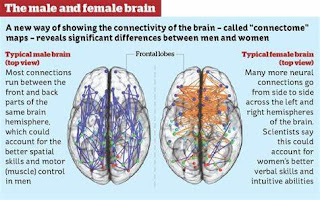
Male and female are suggested to have different brain structures. How their brains work is significantly influenced by the connectivity of the brain itself, so-called connectome maps. In general, typical male brain connections run between the front and back parts of the same brain hemisphere, either in left or right hemisphere. On the one hand, many more neural connections for female go from side to side across the left and right hemisphere of the brain. The following image illustrates the distinctions between male and female brain structures ( man and female's brain structures images - Bing images - Search Images ) What can we suggest from that finding in pertaining to language use among both sexes then? That difference leads to difference in the way how male and female use language. Male, with that brain structure, tends to focus on one particular issue and something logic. It can be illustrated by the fact that when a male meets his male friend, the issue that would be likely to...

"ANU" for All

Anomia is a term to describe a difficult situation to find the correct or relevant word. Dealing with the situation, the speakers tend to express it by describing the object or talking about their purposes. In Indonesian context, most of the speakers replace it by using 'ANU' to refer to various context. This is what I called a universal language. Interestingly, this is so ubiquitous especially in Indonesian context.  ANU is not ANU for Australian National University, or Anti-Narcotic Units. This is unclear where this word comes from. To my mind, that is a clipping processing in Bahasa Indonesia word formation. This seems exaggerated but sounds logical. The idea of clipping refers to the shortening words, or make a word become shorter. This is to create a new word by shortening the original words. For example, Perpustakaan (Library) become Perpus. Gramedia becomes Gramed. Some syllables, especially the last ones, are cut down. In English, we can see Doc for Document, lab for la...

Future Challenges in Education

The increasing technological developments have offered various and more creative approaches in teaching. Traditional methods in teaching-learning activities have been claimed to disappear by 2030. Some believe that technologies are unable to replace how the classroom teaching-learning basis is used to. This is to explore the challenges and shots in the field of future education.  One of the common and realistic challenges for future education is how the way children learn today. Once most of the children are accessible to smartphone and internet, learning sources are available on their hand. YouTube and AI (artificial intelligence) are even more updated than what teachers can do. Topics with sufficient and clear instruction are rich which allow children to be autodidactic. This also allows children to change the way they study as previous generation did.  Moreover, the monotonous teaching approach in the classroom setting is taught to be a significant factor to disappearance o...